
The EU Machinery Regulation (EU) 2023/1230 entirely replaces the Directive. That distinction changes everything for manufacturers, integrators, and compliance teams across Europe.

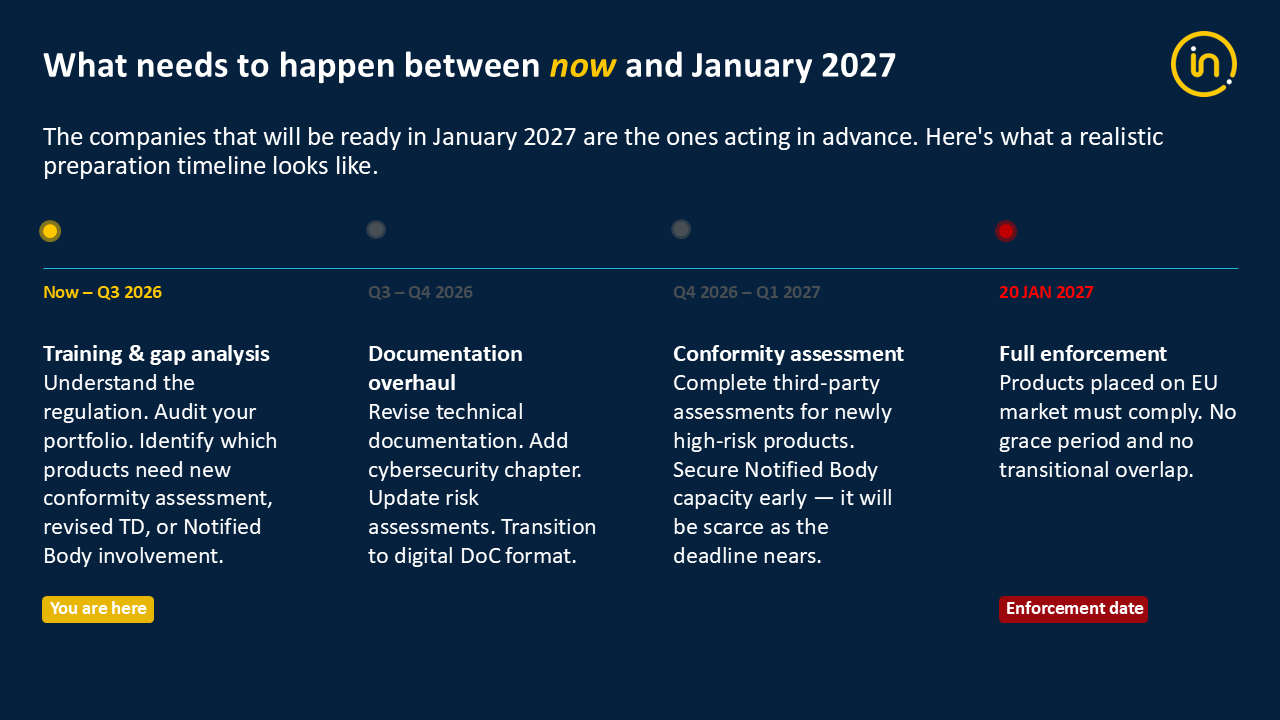
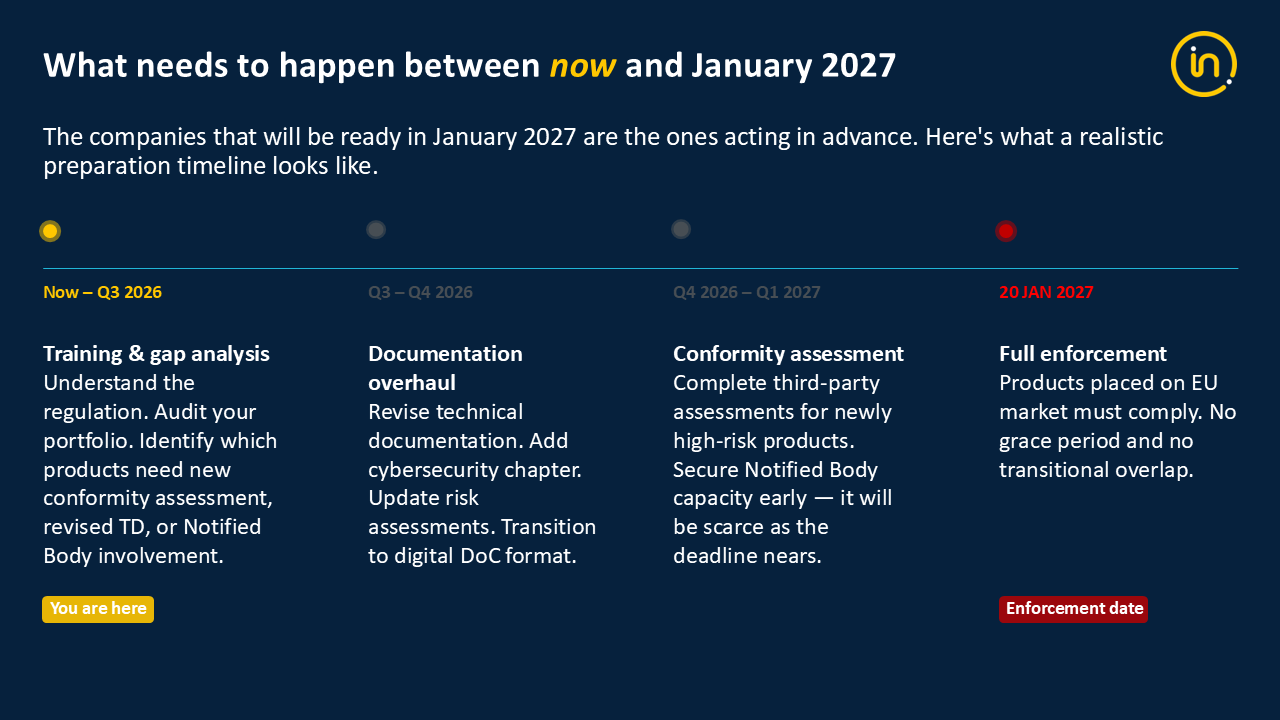
Preparation window is closing: most companies need 12–18 months to be ready.
Gap analysis, documentation overhaul, conformity assessment rethinking, and new third-party certification for high-risk categories all take time. If you haven't started, this course is your fastest route to a concrete action plan.
Are you actually ready for the EU Machinery Regulation?
Most manufacturers believe they're closer to compliant than they are. Think about the items below: has your company already addressed them?
Directive vs. Regulation distinction
We understand the legal difference and what direct applicability means for our multi-market strategy.
Substantial modification policy
We have a documented process for determining when a product change triggers a new conformity assessment.
Cybersecurity requirements
Our technical documentation already addresses cybersecurity risks as defined in Annex III of the new Regulation.
AI-enabled machinery scope
We know whether any of our products use AI that affects safety functions, and what the new requirements entail.
Digital Declaration of Conformity
We have a clear plan for transitioning from paper to digital DoC format with proper accessibility.
High-risk machinery classification
We have audited our full portfolio against the new Annex I A & B categories and third-party certification requirements.
This is not a routine compliance update
Every machinery company has been through directive revisions before. This one is categorically different, and the details are where companies get caught out.
01. A Regulation, not a Directive
Directives leave room for member states to transpose into national law — giving manufacturers flexibility. A Regulation applies directly and identically across all 27 EU markets from day one. No local adaptations, no grace from national bodies. If you sell in multiple EU countries, your single compliance approach just became non-negotiable.
02. The "substantial modification" trap
Software updates, AI integration, safety system changes: under the new Regulation, these can trigger a full new conformity assessment for existing machines, not just new products. Manufacturers with evolving product lines, retrofit programmes, or connected machinery are exposed in ways most legal and compliance teams haven't yet calculated.
03. Cybersecurity as a safety requirement
For the first time, cybersecurity is a mandatory essential health and safety requirement; not a best practice, not an add-on. If your machine can be remotely accessed, updated, or affected by digital inputs, your technical documentation must now demonstrate how you've managed cyber risks. Most existing TDs don't come close.
04. New high-risk categories & third-party mandates
The expanded Annex I now captures machinery categories previously self-certified. If your product falls into a new high-risk category, self-declaration is no longer an option: you need a Notified Body involved in the conformity assessment. Identifying this now prevents a bottleneck as 2027 approaches and Notified Body capacity tightens.
Six modules, half a day, a complete compliance roadmap.
Each module of the course is built around practitioner questions so that by the end, you'll have a structured action plan for your company, not just awareness of the regulation.
Why this change happened, what the legislative shift from directive to regulation actually means, and what the enforcement timeline demands from your organisation right now.
Product scope expansion, new definitions, and the legally-binding concept of "substantial modification": the clause that catches the most companies off guard.
Deep dive into Annex I A & B. Identify whether your products have shifted into mandatory third-party certification territory, and what that means operationally.
Cybersecurity as a mandatory EHSR, AI safety controls, human-machine interface requirements, and autonomous machinery. The most technically demanding module in the course.
Technical documentation structure, the digital Declaration of Conformity, source code availability requirements, and what's changing for partly completed machinery.
Practical tools you leave with: gap analysis framework, standards transition map, risk assessment approach, and Intertek's global support pathways for testing and certification.
Who attends
Built for the people who carry the compliance burden
This course is designed for professionals who need to act on the regulation and not just understand it. It's structured for decision-makers and practitioners alike.
-
Machinery manufacturers and designers
-
Quality and compliance managers
-
Safety engineers and consultants
-
Product certification professionals
-
Import/export managers
-
Legal and regulatory affairs specialists
Upcoming classes
Please note:
Intertek operates under strict standards of independence, impartiality, and integrity. Read more about how we work here: https://www.intertek.com/about/compliance-governance/
Related Links
Upcoming classes

Your trainer: Majipt Sebastin, Team Leader for Machinery and Functional Safety
With over 15 years working directly on machinery conformity assessments across European and global markets, our lead trainer has guided several manufacturers through the original Machinery Directive and has been involved in the regulatory transition process since the Regulation's drafting phase. Every module is built from real project experience, not theory. Expect honest answers to hard questions about your specific situation.
Feedback from previous attendees
Compliance Director Industrial Automation Manufacturer, Germany
"We came in thinking we were broadly ready. By module two we had identified three product lines requiring a full conformity reassessment. That alone justified the cost ten times over."
Head of Quality & Regulatory Affairs Food Processing Equipment OEM, Netherlands
"The substantial modification section was the wake-up call we needed. Nobody on our team had thought through what our annual software update cycle meant under the new rules."
Safety Engineer Robotics Integrator, Sweden
"Genuinely practical. We left with a gap analysis template and a prioritised action list, not just a slide deck to file away."